
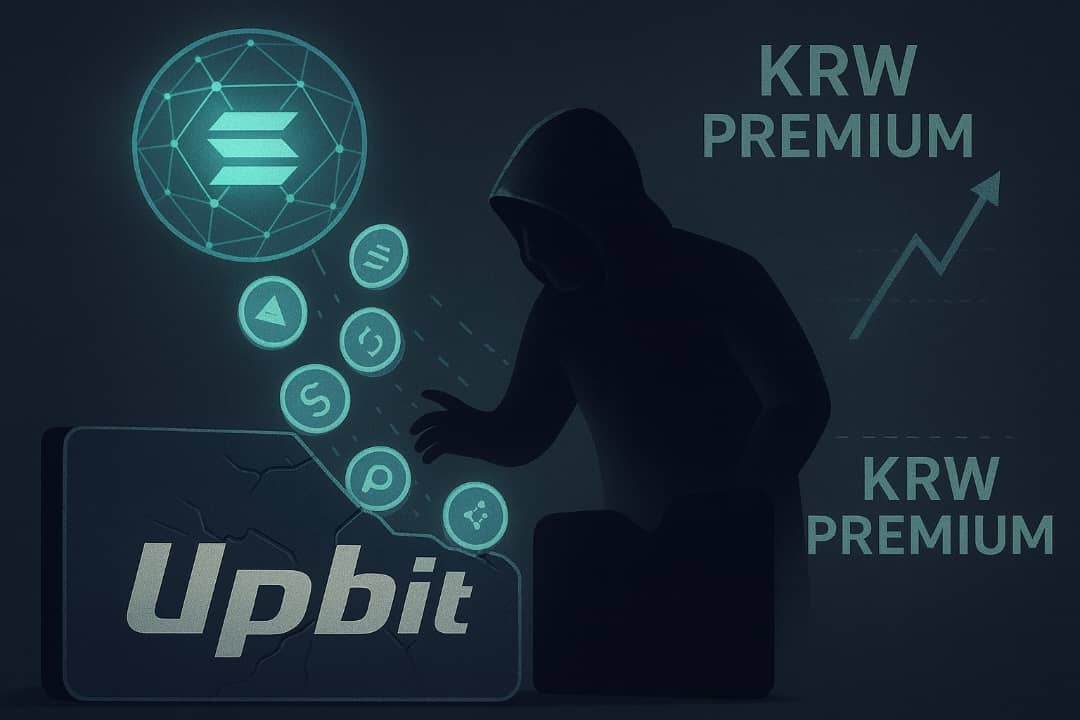
Around dawn on November 27, Upbit confirmed an abnormal outflow of Solana-network assets worth roughly 54 billion KRW (~$38.5 million).
The transfer hit at 04:42 KST, drained funds across multiple Solana-ecosystem tokens, and went straight into unknown external wallets.
Upbit paused all deposits and withdrawals immediately. It’s a normal procedure on paper, but the sudden silence that follows an incident like this is never normal. Something broke inside the fortress, and the market felt the shock.
The Breach: A Multi-Token Drain, Not a Single-Asset Spill
Upbit didn’t lose one token. It lost an entire basket.
The exchange confirmed unauthorized withdrawals involving a long list of Solana tokens:
2Z, ACS, BONK, DOOD, DRIFT, HUMA, IO, JTO, JUP, LAYER, ME, MEW, MOODENG, ORCA, PENGU, PYTH, RAY, RENDER, SOL, SONIC, SOON, TRUMP, USDC, and W.
This wasn’t a small user mishap or a mistaken internal movement. It was wide. Coordinated. Fast.
The chain showed a massive sweep straight to external wallets that nobody with legitimate access should control. Upbit later revised the figures, lowering the confirmed loss to 44.5 billion KRW (~$30.43 million). An additional 2.3 billion KRW (~$1.57 million) worth of Solana-based assets is currently frozen.
The most worrying part isn’t the amount. It’s the angle. A drain across dozens of tokens suggests access at a level far deeper than a single private key slip. Something closer to core liquidity pathways.
And Upbit still hasn’t confirmed the cause.
Immediate Freeze: Hot Wallets Locked, Funds Shifted to Cold Storage
Within minutes of spotting the anomaly, Upbit shut down deposits and withdrawals across all Solana-related assets. The priority became containment, freezing everything that could still be saved.
A few critical points stood out in the exchange’s emergency statement:
- The outflow was not planned internally
- Targeted assets belonged exclusively to the Solana ecosystem
- All funds were quickly migrated to cold storage
- Freeze attempts secured roughly ₩12 billion KRW
- Upbit promises users will take zero loss
And that last line matters. In previous South Korean exchange breaches, user reimbursement wasn’t always immediate. But here, the exchange pledged to cover 100% of the outflow from its own reserves.
That’s a confidence-first approach, necessary, considering Upbit’s reputation as a top-tier security exchange.
A Premium Surge: Solana Tokens Spike on Upbit
And then something strange happened.
While Upbit froze activity, South Korean trader demand didn’t slow down. Instead, it intensified. A supply crunch formed overnight because users couldn’t move tokens on or off the exchange.
Prices broke away from global markets.
ORCA jumped to 3,410 KRW (~$2.33), a premium of more than 25%.
Other Solana tokens saw similar jumps as liquidity thinned and the “Kimchi premium” effect kicked in. Where global markets were stable, Upbit became a pressure cooker.
This dynamic always happens when Korean exchanges lock a token’s channels, but this time the cause wasn’t a normal suspension, it was a hack. That amplified the tension, the speculation, and the urgency.
Regulators Move Immediately: FSS Launches On-Site Inspection
South Korea’s Financial Supervisory Service didn’t wait.
The Virtual Asset Supervision Bureau sent a team directly to Upbit for an on-site inspection, and the review is expected to continue until next Friday. South Korean regulators are known for rapid responses, especially when retail safety is on the line.
Their questions will likely mirror the community’s questions right now:
- How did the outflow occur?
- Was it a key compromise?
- Was there an internal permissions gap?
- Was there a relay or API exploit?
- Was the attack systemic or isolated?
Upbit hasn’t answered anything yet. So far, it has only confirmed the outflow, not the mechanism.
And when a trusted exchange stays quiet, the silence becomes the loudest part of the story.
A Crack in the Fortress
Upbit built itself on a reputation of being “unbreachable.” Institutions trusted it. Retail trusted it. Even skeptics gave it credit. But trust is fragile in crypto. One breach fractures more than user balances, it fractures perception.
Around $36–38 million didn’t just disappear. Confidence did.
One line in the commentary from your provided data captures the mood:
“When a fortress cracks, the shock isn’t the loss, it’s the silence that follows.”
Because the chain shows everything. A clean sweep. A precise timestamp. A wallet nobody recognizes. And no public explanation from the exchange.
For now, blockchain explorers tell a clearer story than the exchange does. The assets left. They landed where they shouldn’t. And until Upbit discloses what happened, the market is left waiting, and watching.
Upbit will reimburse the losses, secure user assets, and stabilize Solana-related trading pairs. That part feels certain.
What remains uncertain are the deeper issues:
- Was this a one-time breach or a symptom of something systemic?
- Did the attacker exploit infrastructure, not keys?
- Could this same vector exist in other exchanges?
- Will regulators tighten frameworks around hot wallet management?
Crypto exchanges rarely panic publicly. But markets don’t need statements to sense when something is off. They look at chain activity. They look at sudden freezes. They look at premiums erupting out of nowhere.
And right now, all signs point to one truth:
- If Upbit can be breached, everyone else should assume they can be too.
Disclosure: This is not trading or investment advice. Always do your research before buying any cryptocurrency or investing in any services.
Follow us on Twitter @themerklehash to stay updated with the latest Crypto, NFT, AI, Cybersecurity, and Metaverse news!
