
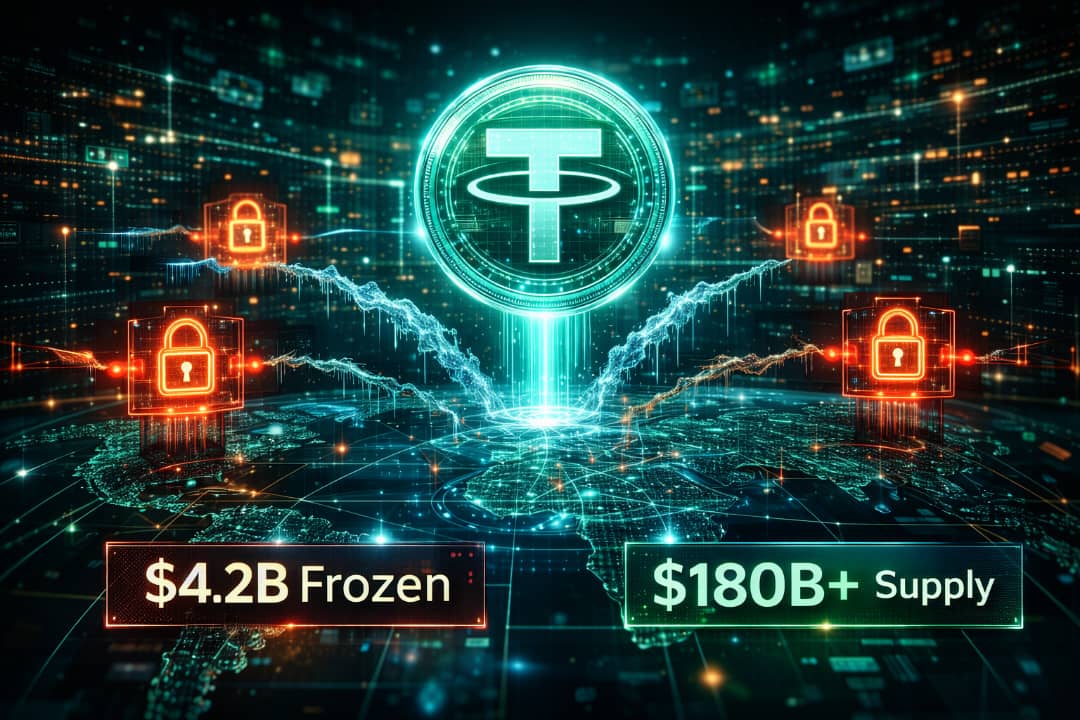
Tether has frozen approximately $4.2 billion worth of USDT linked to illicit activity, marking one of the largest enforcement efforts in the history of the stablecoin market.
According to Reuters, roughly $3.5 billion of that total has been frozen since 2023, signaling an aggressive compliance shift by the world’s largest stablecoin issuer. The figures highlight the scale at which USDT circulates globally, and the level of scrutiny now surrounding its use.
This week alone, Tether assisted U.S. authorities in blocking nearly $61 million tied to so-called “pig-butchering” scams, a fast-growing category of cross-border crypto fraud.
The scale of the freezes underscores a simple reality: stablecoins are no longer operating in a regulatory gray zone. They are deeply embedded in global enforcement frameworks.
As first reported in this update, the enforcement totals continue to climb:
🚨NEW: TETHER FREEZES $4.2B IN USDT LINKED TO ILLICIT ACTIVITY
Tether has frozen roughly $4.2 billion in $USDT tied to criminal cases, @Reuters reports.
About $3.5 billion of that total has been frozen since 2023.
This week, the company assisted the U.S. Department of Justice.… pic.twitter.com/J2SnRMu8kz
— BSCN (@BSCNews) February 28, 2026
Billions Frozen Since 2023
The majority of the $4.2 billion total has been frozen within the past two years.
Since 2023, Tether has locked down approximately $3.5 billion in USDT connected to criminal investigations, sanctions violations, fraud rings, and illicit financial networks. The pace of intervention has accelerated alongside increased cooperation between crypto firms and global regulators.
Unlike decentralized cryptocurrencies such as Bitcoin, USDT operates under centralized issuance. That structure gives Tether the ability to intervene directly when law enforcement presents valid legal requests.
The frozen funds span multiple jurisdictions and criminal categories. Authorities have increasingly turned to blockchain analytics tools to trace suspicious flows, identify wallet clusters, and submit freeze requests in real time.
For critics who have long questioned stablecoin oversight, these enforcement numbers send a strong signal: compliance has become a core operational priority.
DOJ Collaboration Targets Pig-Butchering Scams
This week’s action involved direct cooperation with the U.S. Department of Justice.
Nearly $61 million in USDT connected to “pig-butchering” scams was frozen as part of an enforcement operation. These scams typically involve long-term social engineering tactics in which fraudsters build trust with victims before convincing them to invest in fake crypto platforms.
Losses from pig-butchering schemes have surged globally over the past two years, often running into billions of dollars annually. The scams frequently use stablecoins like USDT because of their liquidity, cross-border functionality, and relative price stability.
By freezing the funds, Tether prevented further movement of the tokens while investigators continue tracing the broader criminal networks involved.
The move also reinforces a growing pattern: major crypto issuers are now working directly alongside federal agencies rather than resisting oversight.
USDT Supply Surges Past $180 Billion
While enforcement activity intensifies, USDT’s market footprint continues expanding.
The total circulating supply of USDT now exceeds $180 billion, cementing its position as the largest stablecoin globally. The growth reflects rising demand for dollar-denominated liquidity across centralized exchanges, decentralized finance platforms, and emerging markets.
USDT functions as a bridge asset in crypto trading pairs, a remittance tool in high-inflation economies, and a liquidity backbone across DeFi ecosystems.
The scale is enormous.
Freezing $4.2 billion sounds significant, and it is, but it represents only a small fraction of total circulating supply. That context matters when evaluating systemic risk or market stability.
At the same time, the sheer size of USDT circulation means enforcement decisions carry meaningful consequences. A freeze can immobilize millions instantly, impacting exchanges, traders, and counterparties.
The Power To Freeze Tokens Remotely
One defining feature separates USDT from decentralized cryptocurrencies: control.
Tether retains the ability to remotely freeze tokens in users’ wallets when presented with valid legal requests from law enforcement agencies. This authority stems from the centralized smart contract controls embedded within the USDT protocol.
When tokens are frozen, they cannot be transferred, redeemed, or moved until further notice.
Supporters argue this capability strengthens compliance and deters criminal use. Critics counter that it introduces counterparty risk and challenges the censorship-resistant ethos often associated with crypto assets.
In practice, the feature has become a standard part of stablecoin operations. Regulators increasingly expect issuers to respond swiftly to court orders, sanctions lists, and criminal investigations.
The $4.2 billion freeze total demonstrates that this capability is not theoretical, it is actively exercised.
A Balancing Act Between Growth And Regulation
Tether now stands at a complex intersection.
On one side, USDT surpasses $180 billion in supply and continues to dominate global crypto liquidity. On the other, enforcement scrutiny intensifies as regulators push for stricter stablecoin frameworks worldwide.
The company’s recent actions signal alignment with authorities rather than resistance. Assisting the Department of Justice, freezing billions tied to illicit networks, and publicly disclosing enforcement totals all suggest a strategic shift toward transparency.
Yet the debate remains unresolved.
Can a centralized stablecoin maintain market dominance while navigating increasing regulatory pressure? Does the ability to freeze funds enhance trust, or undermine decentralization principles?
What is clear is that stablecoins are no longer fringe financial tools. They are now critical infrastructure in digital markets.
By freezing $4.2 billion in USDT linked to criminal activity, including $3.5 billion since 2023, Tether demonstrates both the scale of illicit attempts to exploit crypto rails and the evolving compliance mechanisms designed to counter them.
The numbers are large.
The enforcement is active.
The supply continues to grow.
And as USDT circulation surpasses $180 billion, the balance between expansion and oversight becomes more consequential than ever.
Disclosure: This is not trading or investment advice. Always do your research before buying any cryptocurrency or investing in any services.
Follow us on Twitter @themerklehash to stay updated with the latest Crypto, NFT, AI, Cybersecurity, and Metaverse news!
