
Ethereum is gearing up for its most consequential scalability leap in years.
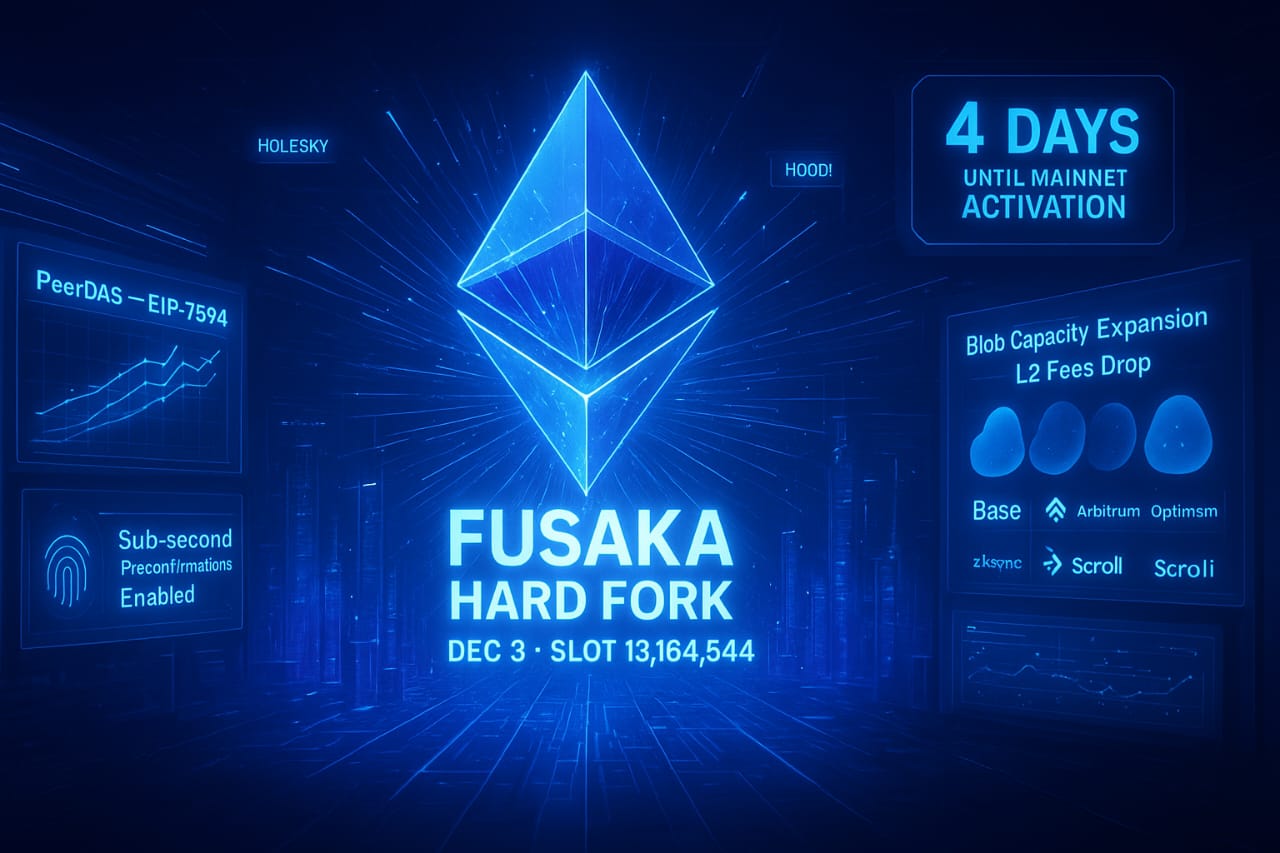
The Fusaka hard fork, the second major network upgrade of 2025 and the most ambitious since The Merge, activates on December 3rd at slot 13,164,544 (21:49 UTC).
After Pectra earlier this year, Fusaka pushes Ethereum further into high-throughput, low-latency territory. It ships a stack of core EIPs designed to improve user experience, strengthen Layer-2 performance, and prepare the chain for long-term decentralization.
#Ethereum’s Fusaka Hard Fork Goes Live on December 3rd
Fusaka, the most ambitious scalability upgrade since The Merge and @ethereum’s second major network upgrade of 2025, activates December 3rd at slot 13,164,544 (21:49 UTC).
Following Pectra earlier this year, Fusaka delivers… pic.twitter.com/ftKKyDDe8P
— Crypto Miners (@CryptoMiners_Co) November 29, 2025
Testnets are ready. Clients are aligned. Audits cleared the final checks.
Four days remain before mainnet flips the switch.
A New Era of User Experience: Faster, Cheaper, Simpler
Fusaka introduces upgrades everyday users will feel immediately.
Near-Instant Transaction Inclusion
Preconfirmations arrive as part of the new upgrade, enabling validators to provide sub-second transaction assurance before finalization. Users get faster feedback. Wallets get snappier. Apps feel instant.
This is the closest Ethereum has come to “tap, send, done.”
Native Passkey Support (EIP-7951)
Fusaka integrates secp256r1 (P-256) as a precompile, a long-requested feature that brings native support for passkeys and WebAuthn.
This move:
- aligns Ethereum with global authentication standards,
- improves wallet UX,
- and makes account-abstraction flows far smoother.
Corporate and enterprise users also gain compatibility with existing security hardware.
Lower Layer-2 Fees Through Blob Capacity Improvements
Blob space is increasing after Fusaka, delivered in staged increments through post-upgrade BPO deployments.
This means cheaper data availability for rollups such as:
- Base
- Arbitrum
- Optimism
- zkSync
- Scroll
The result: lower fees for L2 users and a smoother pipeline for rollup throughput.
Massive Boosts for Layer-2s and Rollups
If Pectra set the foundation, Fusaka builds the highway on top.
PeerDAS (EIP-7594)
PeerDAS is the centerpiece, a decentralized sampling system that dramatically increases data availability throughput for rollups without centralizing validators.
Rollups get:
- bigger blocks,
- cheaper posting costs,
- and predictable data bandwidth.
Ethereum gets:
- long-term scalability without compromising security.
Blob Capacity: Gradual, Controlled Expansion
Rather than jumping directly to 48+ blobs per block, Fusaka enables a progressive rollout.
The Blob Pricing Overhaul (BPO) roadmap ensures that:
- fees remain stable,
- client load stays manageable,
- and the network avoids congestion spikes.
More Predictable Data Posting
Rollups gain consistent windows for posting data, a major improvement for sequencers and proving pipelines.
Developers Get Sub-Second Preconfirmations and Cleaner Execution
Fusaka delivers tangible quality-of-life improvements for builders.
Sub-Second Preconfirmations for Apps
Developers can now build experiences that feel instant, a major win for:
- on-chain games,
- DeFi trading interfaces,
- social apps,
- high-frequency marketplaces.
Ethereum is no longer limited by block times for responsiveness.
Execution-Layer Improvements
A series of internal changes streamline execution, setting the stage for future Verkle transitions and more efficient state access.
These are under-the-hood optimizations, but they lower friction for clients and tooling providers across the ecosystem.
Per-Transaction Gas Cap at ~16.7M
A new per-transaction gas ceiling of 2²⁴ (~16.7M) prevents block stuffing and improves mempool reliability.
Node providers like:
- Alchemy
- Infura
- QuickNode
will see more predictable load, fewer outlier transactions, and cleaner block construction.
Node Operators See Gas Target Shifts and Pruning Improvements
Fusaka also touches the backbone of the network: validators and node operators.
Network Gas Target Moving Toward 60M
Ethereum is gradually inching toward a 60M gas target.
Client teams have coordinated extensively to ensure:
- timely encoding,
- stable block sizes,
- and validator readiness.
Updated History Window and Pruning (EIP-7642)
This change reduces storage bloat and brings smarter pruning logic, allowing nodes, especially mid-scale operators, to run longer without manual intervention.
PeerDAS Sampling Load
PeerDAS introduces new sampling responsibilities, but primarily for large validators, not hobbyist stakers.
Teams like:
- Prysm
- Lighthouse
- Teku
- Nimbus
have already validated PeerDAS behavior on testnets.
Institutions Gain Better Key Compatibility and Fee Predictability
Enterprises have long requested more alignment with existing security infrastructure.
Native P-256 Support
With EIP-7951, Ethereum now supports the same curve used in:
- corporate HSMs,
- government systems,
- banking infrastructure,
- mobile security modules.
Companies like Coinbase, Kraken, and Binance benefit from smoother onboarding, reduced operational overhead, and easier account abstraction pathways.
Stable Blob Fee Dynamics Through BPO
Institutional teams can better model costs and throughput as blob fees enter a more predictable lifecycle.
This strengthens Ethereum’s appeal as a settlement layer for high-volume enterprise applications.
Testnets Passed Smoothly, Audits Cleared, No Critical Issues
All major testnets, Holesky, Sepolia, and Hoodi, have already completed Fusaka activation with no major issues.
The Ethereum Foundation conducted:
- audits,
- security contests,
- client coordination calls,
- cross-client validation,
- ahead of mainnet.
Nothing critical was reported publicly.
Ethereum maintains its record:
major upgrades with zero downtime.
Pectra + Fusaka: Two Landmark Upgrades in One Year
With Pectra landing earlier in the year and Fusaka now going live, 2025 becomes one of Ethereum’s most productive years since The Merge.
Two back-to-back network upgrades.
Both focused on performance, UX, and scaling.
Both executed without disruption.
Fusaka’s arrival signals Ethereum’s next phase, faster, cheaper, more decentralized, and ready for the applications that couldn’t exist before.
Disclosure: This is not trading or investment advice. Always do your research before buying any cryptocurrency or investing in any services.
Follow us on Twitter @themerklehash to stay updated with the latest Crypto, NFT, AI, Cybersecurity, and Metaverse news!
