
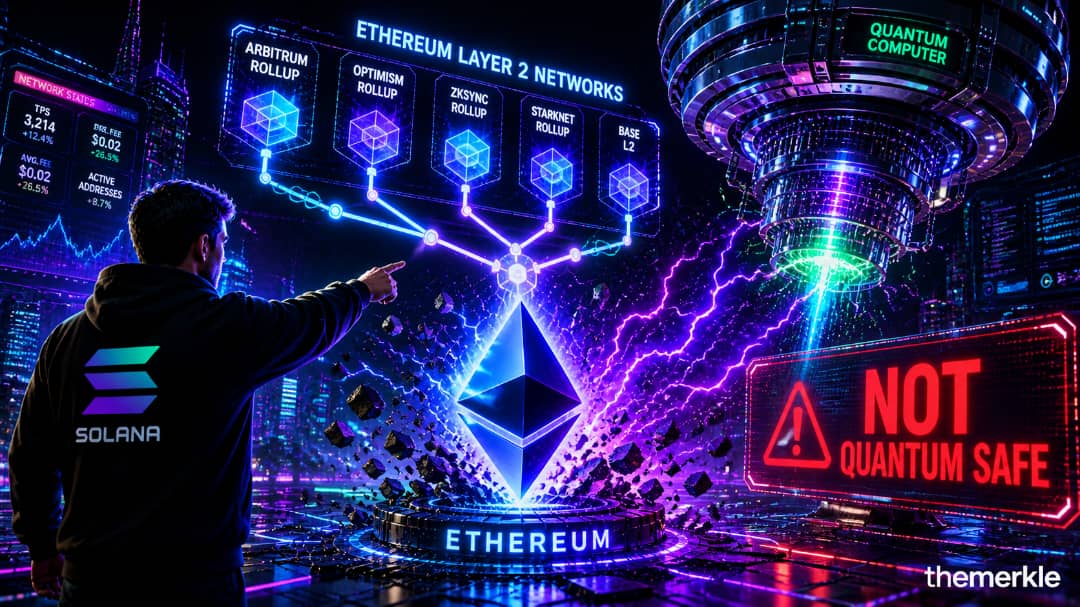
Solana Labs co-founder Anatoly Yakovenko has sparked heated debate within the cryptocurrency ecosystem after issuing a dire warning over the security of Ethereum Layer 2 networks.
Yakovenko had released a public post recently, where he stated that these scaling solutions are “not quantum-safe” using a sentence ending with the words: “abandon all hope.”
This claim, coming from one of the most respected engineers in blockchain infrastructure, is resonating through our industry. His warning is taken not just as criticism but a serious caution about risks and vulnerabilities that may emerge with the evolution of quantum computers.
Ethereum L2s are not quantum safe, abandon all hope https://t.co/GYpAts9RJJ
— toly 🇺🇸 (@toly) May 2, 2026
Quantum Computing Treats are Becoming More Concerning
Yakovenko bases his fears in a letter that has grown more common across the entire tech industry, regarding quantum computing in the long term. Yet even though quantum machines can not yet scale their ability to undermine modern cryptographic systems, experts agree that it’s a question of “when,” not “if” these types of breakthroughs happen.
A core part of this worry stems from whether quantum computers might one day be able to break the cryptographic algorithms that currently keep blockchain networks secure. That risk applies not only to the standards behind Ethereum but also a number of its Layer 2 scaling solutions.
Ethereum Layer 2 networks, specifically created to scale throughput and decrease fees, are built on the security assumptions of the base layer Ethereum chain. In the event that these assumptions get broken by advances in quantum, the fallout will be felt throughout the entire ecosystem.
What Are Ethereum Layer 2 Networks Hosting?
Layer 2 solutions are an essential part of Ethereum’s scaling roadmap technologies like rollups and sidechains; and are built to scale high transaction volume outside of the main chain, while maintaining security guarantees.
Still, Yakovenko implied those fixes might not be enough time to get ready for the coming era of quantum attacks. If they are “not quantum-safe”, Hugo also argued, this means that the cryptographic defenses being used today confront a threat to their usefulness in a post-quantum world.
Such developments present urgent questions of whether current Layer 2 architectures are built with enough foresight for quantum resilience. If post-quantum cryptography is not integrated early, upgrades can be costly and complex, or worse, systemic vulnerabilities that are difficult to fix.
Market Reaction and Community Debate Heat Up
Developers, investors and analysts immediately weighed in on Yakovenko’s comments, addressing the importance or lack thereof of his concerns. Others see his message as an important wake–up call to hasten quantum safe research and adoption.
On the other end, some argue that alarm bells might be ringing too soon. They also point out that quantum computers fast enough to crack blockchain encryption are still years, if not decades, away. Immediate priorities for this perspective could continue to be on scale and UX.
a solana founder saying abandon all hope is genuinely the most optimistic thing said in crypto this year
— SLEPE (@SlepeOnBase) May 2, 2026
Despite these diverging opinions, one thing seems clear: The talking point has left the realm of theory. Perhaps more valuable, Yakovenko’s comments have put the issue front and center in the mainstream, encouraging projects to reckon with an oncoming future that may arrive faster than they realize.
Implications for ETH and its Users
Yakovenko’s warning has massive implications for Ethereum and its huge range of users. That means, if Layer 2 networks turn out to be targetable in some future quantum attack then the security framework of its entire scaling ecosystem may need to be reconsidered.
This may cause developers to integrate post-quantum cryptographic algorithms whose original goal is to be safe against a quantum-enabled adversary. However, the implementation of these algorithms is not easy and there are tradeoffs like computational complexity or performance reduction.
For the users, the matter is palpably tangible: assets and data protection. Although there is no immediate danger, the possibility that security features might weaken over time could affect how investors and institutions might view long-term involvement with the platform.
A Pivotal Moment for Blockchain Security Strategy
An ominous warning from Yakovenko could become a turning point in blockchain security strategy Security is still key at both an operationally-urgent level, and a more strategic long-term resilience level as competition heats up between networks.
Projects that take steps to proactively mitigate quantum vulnerabilities may gain a strategic edge against their competitors, establishing the project itself as an innovator ready for emerging threats. Alternatively, those that delay will find themselves playing catch up when the quantum threat arrives.
Anatoly Yakovenko is telling us one thing and one thing only: the industry has got to stop resting on its laurels. Whether he turns out to be hyperbolic or prescient with his “abandon all hope” admonition, it has certainly changed the conversation.
The future of blockchain does not belong just to the fastest, cheapest protocol but more importantly, it belongs to those that survive as the fundamental laws of computation are rewritten.
Disclosure: This is not trading or investment advice. Always do your research before buying any cryptocurrency or investing in any services.
Follow us on Twitter @themerklehash to stay updated with the latest Crypto, NFT, AI, Cybersecurity, and Metaverse news!
