
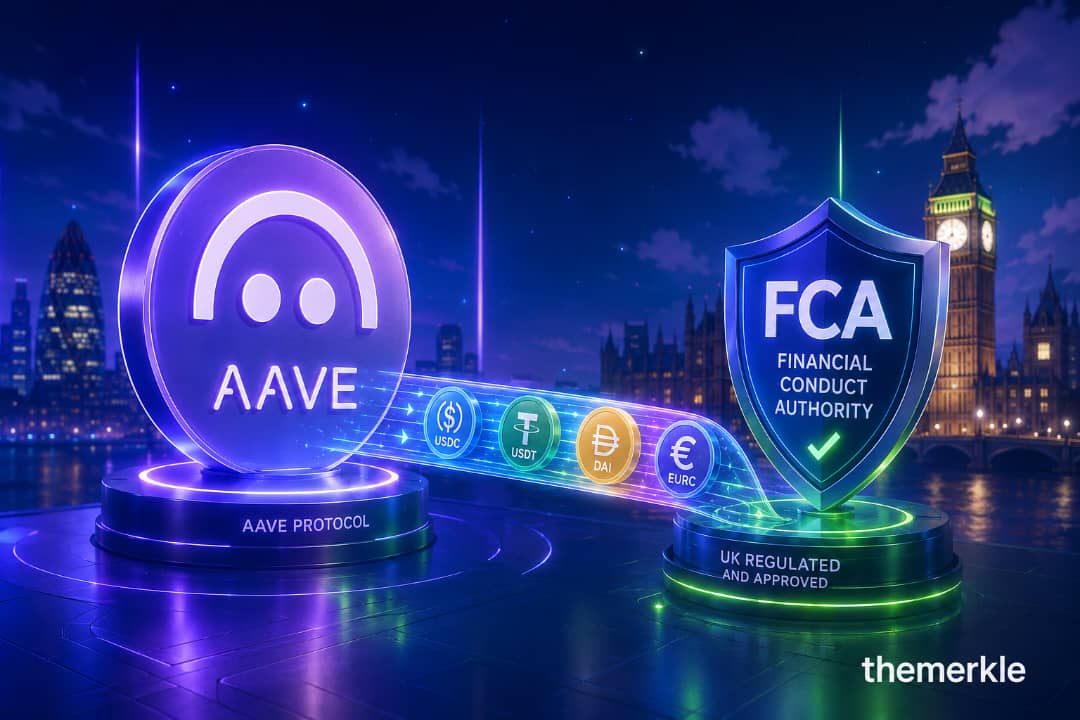
Aave Labs has taken a significant step toward UK regulatory approval following the registration of its subsidiaries, Push Labs Ltd., and Push Virtual Assets Ltd. with the UK’ Financial Conduct Authority (FCA) as cryptoasset exchange providers.
The approval gives its subsidiaries, operating under the Push by Aave Labs brand, the legal ability to perform regulated cryptoasset activities and payment infrastructure services in the UK. This news marks a notable milestone in the continuing integration of decentralized finance (DeFi) infrastructure with traditional regulated finance.
Stick by Aave Labs has received authorisation as an electronic money institution, under the UK Electronic Money Regulations 2011. The authorization expands the companys ability to build payment infrastructure and stablecoin-based financial services in a regulated setting.
The approvals align with Aave Labs’ broader strategy of building a compliant financial infrastructure to bring an order of magnitude more users into blockchain-based DeFi. They stressed that zero-fee on/off ramp infrastructure and stablecoin companies are a core foundation of their long-term vision.
Aave Labs’ UK subsidiaries Push Labs Ltd. and Push Virtual Assets Ltd. (together “Push”) have received approval from the UK’s Financial Conduct Authority (FCA) to register as a cryptoasset exchange provider in the UK. pic.twitter.com/NcoueHDmeS
— Aave (@aave) May 28, 2026
FCA Registration Strengthens Aave’s Regulatory Position
Considering the fact that the UK is one of the top financial jurisdictions worldwide, FCA registration is especially important here.
Crypto companies in the UK have faced growing compliance requirements related to money laundering (AML), operational controls, and financial supervision. As such, FCA approval is a key credibility milestone for any blockchain and digital asset company wanting to expand regulated financial services.
The disclosures state that Push Labs Ltd. and Push Virtual Assets Ltd. were registered as cryptoasset exchange providers and would be subject to the UK’s Money Laundering, Terrorist Financing and Transfer of Funds Regulations 2017.
Those registrations are mainly for AML obligations (the subsidiaries to register with the FCA under the Money Laundering Act) that enable them to conduct regulated cryptoasset services compliant with UK financial supervision standards.
Both subsidiaries even received official FCA registration reference numbers alongside their names, highlighting the formal and almost rigorous approval process demanded.
Such regulatory approvals are becoming increasingly important for DeFi firms in particular, as the space matures from being primarily crypto-native ecosystems towards broader integration with the global financial system.
These permissions allow Push by Aave Labs to operate regulated cryptoasset activities and payments infrastructure in the UK.
Aave Labs is building for the next million users, and regulated products with zero-fee stablecoin on/off-ramping are necessary to do it.
— Aave (@aave) May 28, 2026
Push By Aave Labs Expands Beyond Traditional DeFi
These approvals have also provided examples of how Aave Labs is expanding the scope of its ambitions from its core decentralized lending infrastructure into broader financial services and payments systems.
AAVE is a well-known decentralized lending protocol that allows users to lend and borrow digital assets without the need for typical banking institutions via the use of smart contracts.
Push by Aave Labs is a manually purposeful expansion into regulated payments infrastructure, stablecoin rails & fiat integration services.
The most impactful of these is the Electronic Money Regulations 2011 authorisation which enables Push to provide UK regulated electronic money products.
The development opens the door for a wide range of regulated payment services, from stablecoin payment systems to fiat currency conversion infrastructure and possibly consumer-facing financial products backed by blockchain networks.
Regulated products supporting zero-fee stablecoin on-boarding and off-boarding will be key to bringing the “next million users” into DeFi ecosystems, according to Aave Labs.
This shows that the whole industry understands that the only way to drive user adoption is to make it very easy for people to bridge traditional banking infrastructure across to one based in blockchain.
Stablecoin Infrastructure Emerges as a Central Growth Area
Elsewhere in the news, the announcement also tiny boosts how quickly stablecoin infrastructure has developed as a key focal point across the global crypto markets.
Stablecoins provide the vital link between traditional finance and decentralized ecosystems to an ever-increasing degree. They support a diverse set of activities spanning trading, payments, remittances, lending, treasury and cross-border settlement across the digital asset ecosystem.
As a result, there is growing interest in the regulated stablecoin infrastructure from crypto-native firms and traditional financial institutions.
Aave Labs seems to be angling to put Push at the forefront of this nascent category.
Infrastructure that enables zero-fee on-ramping and off-ramping could potentially change frictionless transition for users between fiat currencies and blockchain ecosystems. One of the primary challenges that stands in the way of wider mainstream adoption is simplifying these transitions.
At the same time, regulatory payment infrastructure permits protocols such as Aave to work more harmoniously alongside existing financial systems while preserving blockchain-native function.
Eventually, the combination of DeFi infrastructure and regulated payment systems / stablecoin rails could lead to hybrid financial ecosystems that utilize elements from both, allowing standardized retail websites (like Coinbase, Kraken, etc.) to easily service institutional partners.
Aave Pursues A Global Regulatory Strategy
The FCA nod is also a key part of what Aave founder Stani Kulechov described as the company’s global regulatory strategy.
The UK approval, as stated in the announcement, builds on Push’s existing Markets in Crypto-Assets (MiCA) authorisation across the European Economic Area and EU.
This indicates that Aave Labs is building a regulatory framework aimed at cross-jurisdiction financial infrastructure across multiple major markets.
This is part of growing trend within more established crypto firms. Instead of circumventing regulation, top blockchain companies are increasingly pursuing formal licenses, payment authorizations and regulated financial permissions with insurers in major world jurisdictions.
Such a strategy might become even more essential as governments tighten control of stablecoins, cryptoasset services and the infrastructure to facilitate blockchain-based payments.
Concurrently, she explained in the statement, regulatory approvals provide substantial competitive advantages. Companies that operate under recognised financial modalities are usually afforded greater institutional trust, wider banking relationships and easier routes to mainstream adoption.
In the case of Aave Labs, these approvals put the company in a position to grow beyond decentralized lending and into the realm of regulated digital financial infrastructure at large.
The allowance of new cryptoasset exchange permissions and electronic money action, the announcement of a regulated mint that can enable any cryptocurrency to be backed in fiat at scale from exchanges (referred to as a Stablecoin), will change lives for many DeFi companies for decades as they take on both more global reach and regulatory requirements.
In an ever-evolving world where many projects can exist as permissionless protocols, living solely outside of traditional systems, entities like Aave Labs are developing hybrid financial infrastructures aimed at connecting the future-forward finance of blockchain-native markets with regulatory-friendly pathways to the global capital pools already in place.
With the expansion of stablecoins, tokenized assets and blockchain payments globally, companies who are tech savvy but able to work within regulatory parameters could become the most powerful builders inside a nascent digital finance ecosystem.
Disclosure: This is not trading or investment advice. Always do your research before buying any cryptocurrency or investing in any services.
Follow us on Twitter @themerklehash to stay updated with the latest Crypto, NFT, AI, Cybersecurity, and Metaverse news!
