
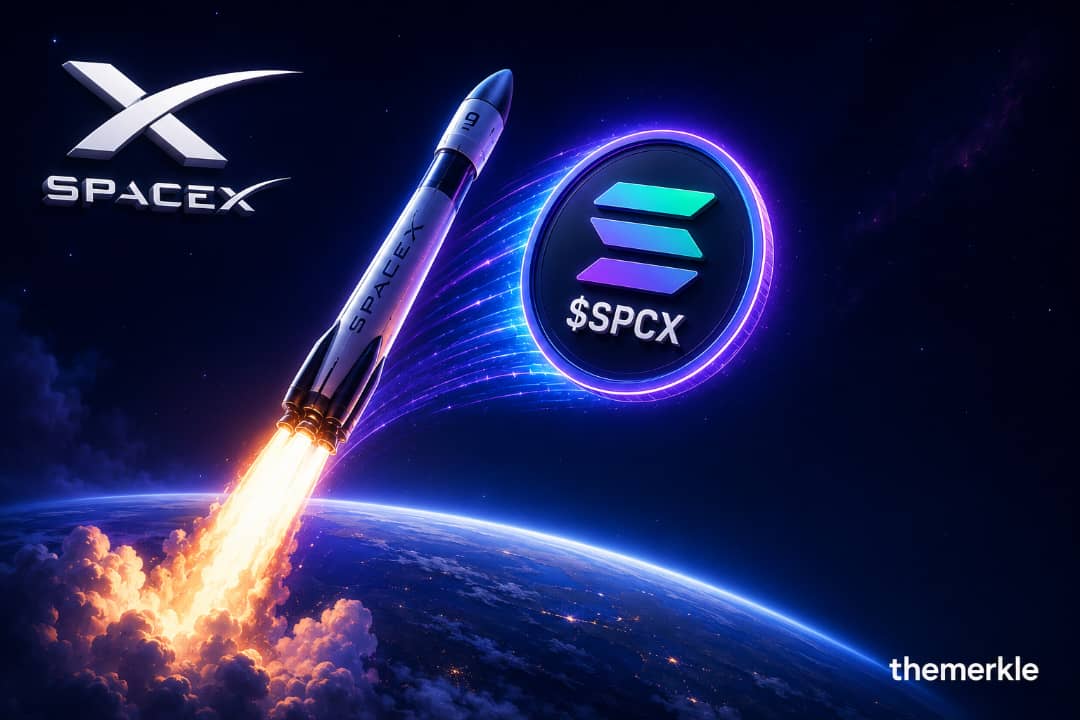
Nothing in the history of public markets has looked like this. The SpaceX IPO prices tomorrow, and the numbers are so large they barely feel real.
Over $250 billion in total orders received. Retail interest alone crossing $70 billion. Thirty percent of shares reserved for everyday investors. A valuation touching $1.8 trillion. And for crypto natives who want exposure from day one, a tokenised SpaceX share called $SPCX is going live on Solana the same day, trading around the clock, backed one-to-one by real shares, and redeemable directly into a brokerage account.
Friday is going to be a day the markets talk about for a very long time.
The Numbers That Put This IPO in a Category of Its Own
The Kobeissi Letter laid out the scale, and it is worth reading slowly. SpaceX is raising $75 billion in this offering. The previous record for the largest IPO in history was Saudi Aramco in 2020, which raised $29.4 billion. Retail interest in SpaceX alone, not total orders, just retail, has now exceeded $70 billion. That single number is 2.4 times larger than the entire amount raised in what was previously the biggest IPO ever recorded.
Total orders received have crossed $250 billion against a $75 billion raise, meaning the offering is oversubscribed by approximately 3.5 times. At $135 per share, the valuation sits at $1.8 trillion, making SpaceX one of the most valuable companies on earth from the moment it begins trading. Roughly 4,000 SpaceX employees are set to become millionaires through the listing. The company has committed 30% of its shares to retail investors, a deliberate decision that reflects Elon Musk’s stated goal of democratising access to the record debut.
For context, the platforms confirmed to offer SpaceX shares to retail investors include Robinhood, Fidelity, Schwab, SoFi, and E-Trade. If you have an account on any of those platforms, you have a direct path to one of the most anticipated IPO allocations in history.
$SPCX Brings SpaceX to Solana the Same Day
The traditional brokerage route is one path. For crypto users, Solana announced a different one. $SPCX is a tokenised SpaceX share launching on Solana through Sunrise DeFi after Friday’s IPO, and the structure behind it is designed to be genuinely redeemable rather than purely synthetic. Every $SPCX token is backed by a real SpaceX share, redeemable on a one-to-one basis directly into your brokerage account through Backpack Securities.
That redemption mechanism matters. The crypto space has seen plenty of tokenised asset products that offer price exposure without actual ownership rights. $SPCX is built differently, the backing is real, the redemption path is defined, and the delivery vehicle is Backpack Securities, which provides the regulated bridge between the on-chain token and the underlying equity. For DeFi users who want to hold SpaceX exposure on-chain without opening a traditional brokerage account, this is the most direct route available at launch.
Trading on Solana means $SPCX operates twenty-four hours a day, seven days a week, including through weekends and after-hours sessions when traditional equity markets are closed. At a moment when around-the-clock trading of real-world assets is becoming one of the defining narratives in crypto, SpaceX landing on Solana on IPO day is a significant proof of concept for the broader tokenised equities thesis.
Retail Gets 30% and the Demand to Fill it is Already There
The decision to allocate 30% of the offering to retail investors is not just a PR gesture. It is a structural commitment that came directly from Elon Musk’s vision to make the SpaceX IPO accessible beyond the institutional investor community that typically dominates large offerings. In most IPOs of this scale, retail participation is a token gesture, a few percentage points carved out to generate goodwill while the bulk of the allocation goes to hedge funds, sovereign wealth funds, and large asset managers.
SpaceX is doing the opposite. Thirty percent of a $75 billion raise directed toward retail investors represents $22.5 billion in shares available to everyday buyers. Given that retail interest has already exceeded $70 billion, more than three times that allocation, the demand is not the constraint. The constraint is supply, and even with 30% reserved, most retail applicants are going to receive a fraction of what they requested through standard allocation processes.
What $1.8 Trillion Actually Means in Context
A valuation of $1.8 trillion places SpaceX comfortably inside the tier of the world’s most valuable companies. For reference, this puts SpaceX in the same conversation as Apple, Microsoft, Nvidia, and Saudi Aramco, companies that took decades to reach comparable valuations. SpaceX is getting there on IPO day, driven by a combination of its dominance in commercial launch services, the Starlink satellite internet business that has been generating real revenue at scale, and the long-term optionality attached to Musk’s Mars colonisation ambitions.
The market is not pricing SpaceX as a launch services company. It is pricing it as the infrastructure layer for humanity’s expansion beyond Earth, a narrative that commands a premium no discounted cash flow model can fully capture. Whether that premium is sustainable post-IPO or whether the stock gives back some of its opening enthusiasm in the weeks following listing is the question institutional analysts are debating. What is not up for debate is that the demand signal coming from $250 billion in total orders is one of the most unambiguous statements of market conviction in the history of public offerings.
Disclosure: This is not trading or investment advice. Always do your research before buying any cryptocurrency or investing in any services.
Follow us on Twitter @themerklehash to stay updated with the latest Crypto, NFT, AI, Cybersecurity, and Metaverse news!
