
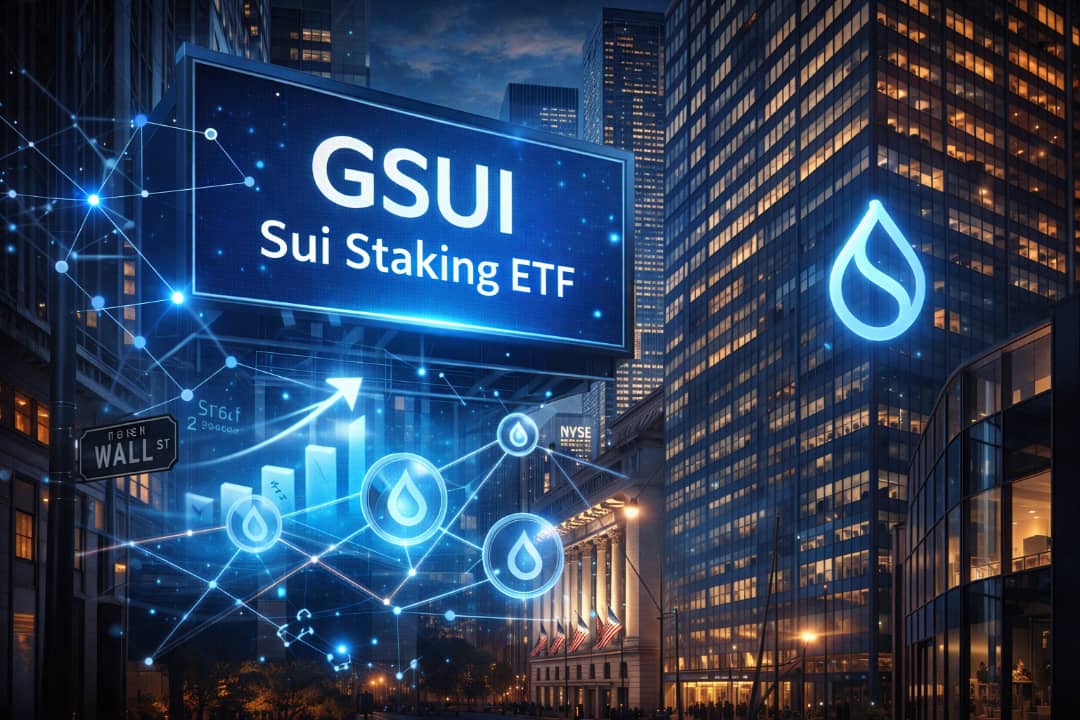
A new milestone in the evolution of crypto investment products is set to unfold as the first U.S. exchange-traded product focused on the Sui blockchain prepares to begin trading.
The Grayscale Sui Staking ETF, trading under the ticker GSUI, introduces a structure designed to give investors direct exposure to SUI while also passing through staking rewards, a feature that sets it apart from traditional spot crypto ETFs.
The product represents a significant step in bridging decentralized networks with traditional capital markets. By combining regulated market access with native blockchain yield, the ETF highlights how investment vehicles are evolving to reflect the economics of proof-of-stake ecosystems.
https://Twitter.com/Grayscale/status/2024114873916133841
Listing Approval Marks Transition To Regulated Product
NYSE Arca has formally approved the listing and registration of the Grayscale Sui Staking ETF, certifying its transition from the earlier trust structure into a fully regulated exchange-traded product. The certification, dated February 17, 2026, represents the final step before public trading begins.
The ETF is scheduled to start trading on February 19, 2026, marking the first time U.S. investors can access SUI exposure through a listed vehicle on a national securities exchange. The approval also underscores growing regulatory openness toward more complex crypto-linked financial instruments, particularly those tied to proof-of-stake networks.
The shift from trust to ETF structure is significant because it typically enhances liquidity, improves price tracking, and broadens accessibility for institutional and retail investors alike.
A Product Built Around Staking Economics
Unlike conventional spot ETFs that simply track the underlying asset, GSUI incorporates staking into its structure, enabling shareholders to benefit from network rewards. Historically, SUI staking yields have ranged between approximately 1.7% and 3.3%, and the ETF aims to pass these rewards directly to investors.
This design effectively blends capital appreciation potential with yield generation, aligning the product more closely with how native blockchain participants earn returns. For investors, it offers exposure not just to price movements but also to the economic activity occurring on the network.
The staking component reflects a broader trend in digital asset investment products, where yield-bearing structures are becoming increasingly attractive as investors seek diversified sources of return.
Institutional Infrastructure Supports The Launch
The ETF’s operational framework includes established financial institutions responsible for key roles. BNY Mellon will act as administrator, overseeing fund operations, while Coinbase will serve as custodian and prime broker.
This combination of traditional financial infrastructure and crypto-native expertise illustrates how the industry continues to converge. Institutional involvement is often viewed as a critical factor in building confidence among large investors, particularly those requiring robust custody and compliance standards.
By leveraging experienced partners, the product aims to provide a seamless bridge between regulated markets and decentralized network exposure.
Why Sui’s Growth Makes Timing Significant
The launch comes amid a period of accelerating activity on the Sui network. Total value locked (TVL) has been rising in early 2026, signaling growing adoption across decentralized applications and financial services built on the chain.
Sui is designed as a high-performance Layer-1 blockchain focused on delivering fast, low-cost transactions and user-friendly experiences. Its architecture emphasizes scalability and efficiency, positioning it as a platform for real-world applications that require high throughput.
As network usage increases, investment products tied to the ecosystem gain relevance, providing traditional market participants with a structured way to participate in its growth. The ETF effectively acts as an institutional on-ramp, channeling capital into the ecosystem while offering exposure through familiar investment channels.
https://Twitter.com/SuiNetwork/status/2024116179460378845
How The ETF Changes Access To Layer-1 Assets
Historically, gaining exposure to emerging blockchain networks required direct token purchases through crypto exchanges, a process that can involve custody considerations and operational complexity. The introduction of GSUI simplifies this process by embedding exposure within a regulated investment vehicle.
For institutions with strict compliance requirements, ETFs provide a familiar structure that aligns with existing portfolio management frameworks. This accessibility could broaden the investor base for SUI, potentially increasing liquidity and market participation over time.
At the same time, the inclusion of staking rewards differentiates the product from earlier crypto ETFs, which typically focused solely on price tracking. The model reflects a deeper integration of blockchain-native economics into traditional financial products.
A New Chapter For Crypto Investment Products
The debut of the Grayscale Sui Staking ETF highlights how the intersection of blockchain technology and traditional finance continues to evolve. As networks mature and regulatory clarity improves, more specialized investment vehicles are likely to emerge, offering targeted exposure to specific ecosystems and features.
For the broader market, the launch signals growing confidence in proof-of-stake networks as investable assets. It also demonstrates how institutional demand is shaping the design of crypto financial products, pushing them beyond simple price exposure toward structures that capture the full economic value of participation.
If successful, GSUI could set a precedent for future staking-enabled ETFs tied to other networks, potentially accelerating the integration of decentralized finance principles into mainstream investment strategies.
The listing of the Grayscale Sui Staking ETF represents a convergence of technological innovation and financial infrastructure. By combining regulated access, staking rewards, and institutional support, the product underscores the expanding role of digital assets in global capital markets.
As trading begins, the ETF will serve as a key test case for how investors respond to yield-bearing crypto products, and whether the model can unlock a new wave of institutional participation in next-generation blockchain ecosystems.
Disclosure: This is not trading or investment advice. Always do your research before buying any cryptocurrency or investing in any services.
Follow us on Twitter @themerklehash to stay updated with the latest Crypto, NFT, AI, Cybersecurity, and Metaverse news!
