
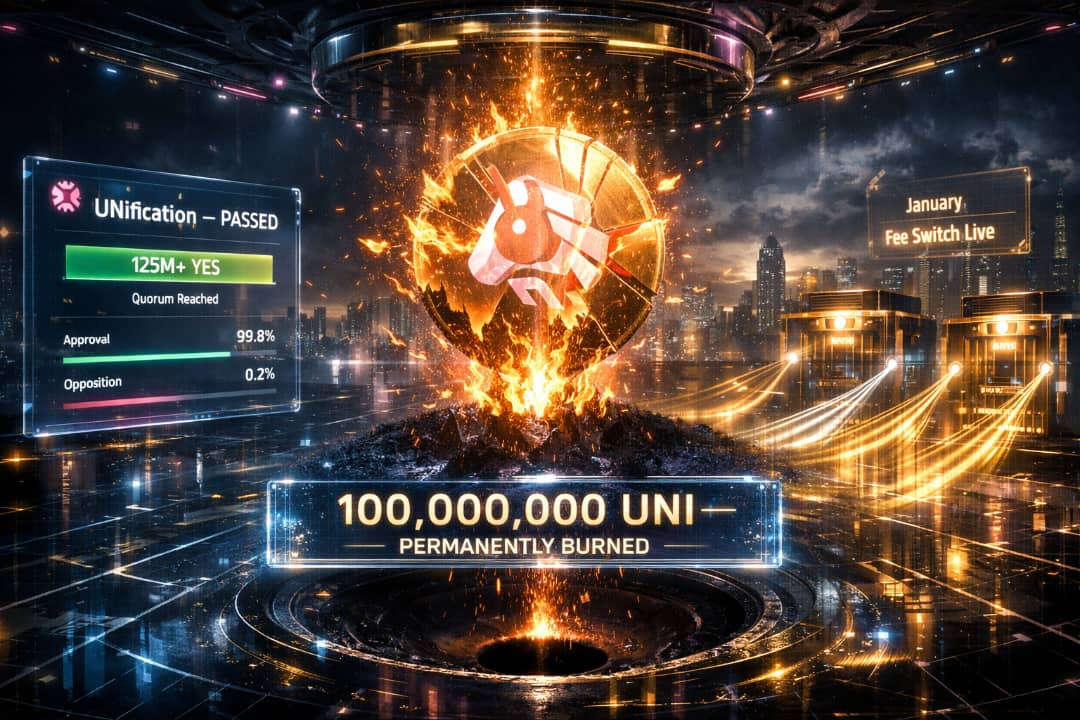
Uniswap has crossed a line it has debated for nearly four years. Following the approval of the UNIfication proposal, the Uniswap treasury has officially burned 100 million UNI tokens, worth approximately $591 million, sending them to an irrecoverable burn address.
The transfer was confirmed by Uniswap in a public update.
UNIfication has officially been executed onchain
✓ Labs interface fees are set to zero
✓ 100M UNI has been burned from the treasury
✓ Fees are on for v2 and a set of v3 pools on mainnet
✓ Unichain fees flow to UNI burn (after OP & L1 data costs)
Let the burn begin pic.twitter.com/fcr3WY3gPc
— Uniswap Labs 🦄 (@Uniswap) December 27, 2025
The burn represents 10% of UNI’s maximum supply, immediately reducing long-term circulating potential and marking the most aggressive supply reduction move in Uniswap’s history. Even after the burn, the Treasury Timelock Contract still holds 269 million UNI, leaving the DAO with substantial remaining resources while materially changing token economics.
This moment finalizes years of governance debate around value accrual, fee alignment, and sustainability. UNIfication has not just passed. It has been executed.
UNIfication Passes With Overwhelming Support
The vote was not close.
More than 125 million UNI votes were cast in favor of the proposal, comfortably exceeding quorum and reflecting one of the strongest governance consensuses seen in DeFi to date. Opposition was minimal. The outcome was decisive.
At its core, UNIfication does three things at once. It activates protocol fees, redirects value to UNI holders, and establishes a long-term funding model without relying on inflationary emissions.
The market reaction had already begun before the burn was executed. UNI rallied roughly 25% during the voting period, as traders and long-term holders positioned for a structural shift rather than a short-term catalyst.
Governance rarely moves this cleanly in DeFi. The scale of agreement signals something larger than a single proposal. It suggests Uniswap’s community is aligned around maturity, sustainability, and capital discipline.
100M UNI Burn Changes Supply Math
The numbers matter.
The 100 million UNI burned equates to roughly $594 million at current prices and permanently removes a significant portion of supply from future circulation. This is not a temporary lock or vesting delay. These tokens are gone.
From a tokenomics perspective, this immediately tightens long-term supply expectations. UNI has long faced criticism for weak value capture despite dominant protocol metrics. That criticism now has an answer.
The burn also changes how the treasury is perceived. Rather than a passive reserve, it becomes an active tool for managing supply and reinforcing governance credibility.
Importantly, this burn does not exhaust treasury capacity. With 269 million UNI still held, the DAO retains flexibility to fund development, incentivize growth, or pursue future strategic initiatives without undermining scarcity.
The move signals restraint. And restraint, in crypto, often carries more weight than expansion.
Fee Switch Turns On In January
The burn is only part of the shift.
The UNIfication proposal also activates the long-awaited fee switch, set to go live in January. For the first time since 2020, a portion of Uniswap’s protocol fees will flow to UNI holders rather than being fully retained by liquidity providers.
Specifically:
- Protocol fees are activated on v2
- A set of v3 pools on mainnet will also have fees enabled
- Unichain fees will flow directly into UNI burns, after accounting for OP stack and Layer-1 data costs
In parallel, Uniswap Labs interface fees are set to zero, eliminating friction for users while separating front-end economics from protocol-level value capture.
This restructuring aligns incentives across users, builders, and token holders. It also resolves a long-standing tension between growth and sustainability that has defined DeFi’s first era.
Uniswap is no longer purely volume-driven. It is now revenue-aligned.
A Revenue Giant With A Discounted Token
The contrast is stark.
Uniswap processes roughly $80 billion in monthly volume and generates an estimated $700 million in annual revenue. Few protocols operate at this scale. Fewer still do so without significant inflation or leverage.
Yet despite these fundamentals, UNI trades around $6.30, down roughly 40% year-to-date. For years, this disconnect fueled criticism that UNI was a governance token without real economic gravity.
That narrative now weakens.
With protocol fees redirecting value to token holders and a significant portion of supply permanently removed, UNI’s valuation framework changes. The market can no longer ignore cash flow.
As Entropy Advisors noted, this shift reframes UNI from a passive governance asset into one with explicit participation in protocol economics.
Early Christmas Present from Uniswap, 100M UNI has been transferred to the Burn Address from Uniswap Treasury! 🤶
It represents 10% of the max supply ($594M). Currently, the Treasury Timelock Contract still holds 269M UNI Token.
In addition to the token burn, the UNIfication… pic.twitter.com/K4J1mtUGuG
— Entropy Advisors (@EntropyAdvisors) December 28, 2025
Repricing does not happen overnight. But structures matter. And this one is built to endure.
What This Means For DeFi Going Forward
UNIfication is bigger than Uniswap.
It sets a precedent for how mature DeFi protocols evolve. Growth-first is giving way to sustainability-first. Emissions are being replaced by discipline. And governance is proving it can act decisively when incentives align.
This vote also sends a signal to other DAOs sitting on large treasuries. Token burns, fee switches, and clearer value capture are no longer theoretical. They are executable.
For UNI holders, the change is structural, not speculative. Supply is lower. Fees are coming. And governance credibility has been strengthened.
For DeFi broadly, this moment marks a shift away from endless expansion toward capital efficiency.
Uniswap did not promise the moon. It changed the math.
And in crypto, when the math changes, everything else eventually follows.
Disclosure: This is not trading or investment advice. Always do your research before buying any cryptocurrency or investing in any services.
Follow us on Twitter @themerklehash to stay updated with the latest Crypto, NFT, AI, Cybersecurity, and Metaverse news!
