
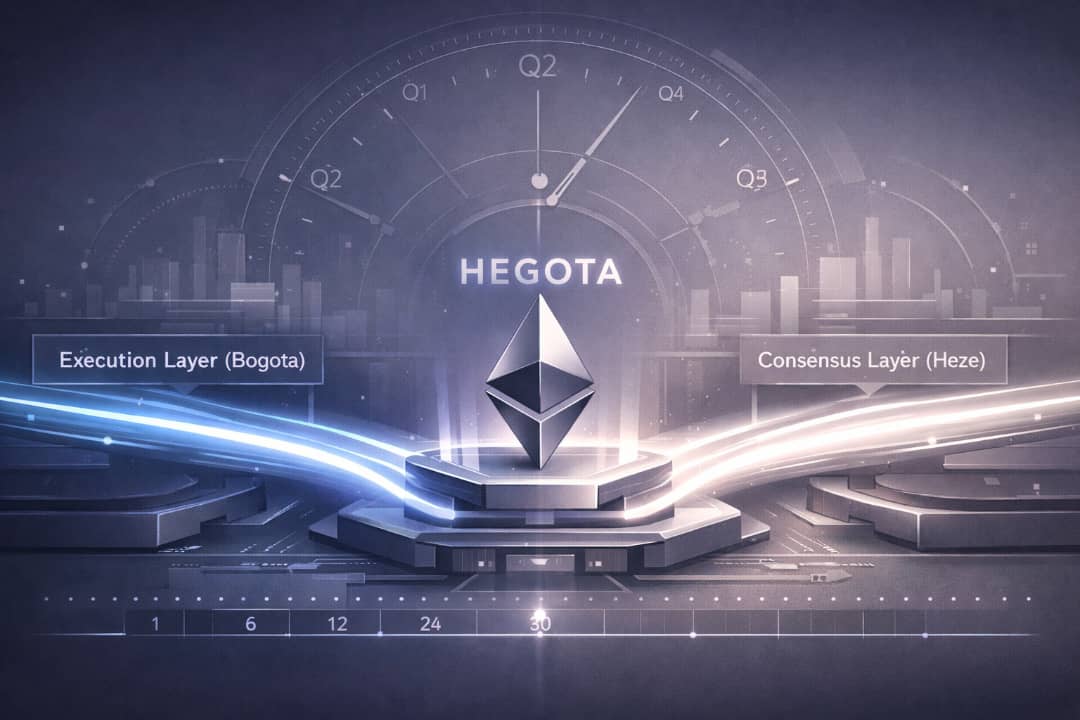
Ethereum developers have officially named the network’s post-Glamsterdam 2026 upgrade Hegota. The name merges two parallel tracks into a single release: Bogota for the execution layer and Heze for the consensus layer.
This isn’t just branding. It reflects how Ethereum now ships upgrades, coordinated, predictable, and incremental.
Hegota will land later in 2026, following Glamsterdam, which is scheduled as Ethereum’s first upgrade of the year. Together, they continue the network’s now-established twice-yearly upgrade cadence, a model that Ethereum devs have been steadily refining.
Instead of rare, dramatic forks, Ethereum now opts for smaller, clearly scoped upgrades that are easier to test, ship, and adopt. Hegota fits squarely into that philosophy.
For now, the upgrade is still in planning. The headline EIP for Hegota hasn’t been selected yet. That decision is expected in February, while development attention remains focused on delivering Glamsterdam on schedule.
Ethereum developers named the post-Glamsterdam 2026 upgrade “Hegota,” combining execution-layer Bogota and consensus-layer Heze. Hegota will follow Glamsterdam later in 2026 as part of Ethereum’s twice-yearly upgrade cadence, with potential focus areas including Verkle Trees,…
— Wu Blockchain (@WuBlockchain) December 19, 2025
What Hegota Is , and Why the Name Matters
Hegota combines two traditions.
On the execution side, Bogota follows Ethereum’s long-running practice of naming execution-layer upgrades after Devcon host cities. On the consensus side, Heze continues the newer convention of naming upgrades after stars.
By merging the two into Hegota, Ethereum signals a unified release across both layers. One coordinated upgrade. One deployment window. One set of goals.
But the bigger message isn’t the name. It’s the intent.
Developers have been clear: Hegota is not about flashy features or user-facing gimmicks. It’s about reinforcing Ethereum’s role as a global settlement layer. That means reliability first. Predictability first. Stability under stress.
This is the kind of upgrade institutions care about. Less downtime risk. More deterministic execution. Fewer edge-case failures.
Ethereum isn’t chasing hype cycles anymore. It’s optimizing for decades of usage.
The Shift to a Predictable Upgrade Rhythm
Ethereum’s upgrade process has matured.
With Pectra and Fusaka shipped in 2025, the network locked in a rhythm of two upgrades per year. That cadence changes everything. It allows improvements to be iterative rather than overloaded. Narrow rather than sprawling.
If a proposal isn’t ready, it doesn’t stall the entire roadmap. It simply moves to the next upgrade.
That’s exactly how Hegota fits into the picture.
Glamsterdam will likely launch in the first part of 2026. Anything too complex, too risky, or too late for that window gets pushed to Hegota later in the year. No drama. No rush.
This approach reduces coordination risk across clients, validators, and tooling. It also makes Ethereum easier to plan around for builders and infrastructure providers.
Upgrades become expected events, not existential moments.
What Hegota Is Likely to Focus On
While no final scope has been locked in, several focus areas are already being discussed for Hegota.
At the top of the list: Verkle Trees.
Verkle Trees are designed to dramatically reduce the burden of running an Ethereum node. By shrinking the amount of data nodes need to store and verify, they make the network more accessible and resilient.
That matters because Ethereum’s state keeps growing. Every smart contract. Every account. Every interaction adds data. Over time, this makes node operation more demanding, and centralization risk creeps in.
Hegota is expected to address this through:
▪️ State management improvements
▪️ Reducing long-term data overhead
▪️ Execution-layer optimizations
These aren’t flashy changes. But they directly impact validator efficiency, client resilience, and network stability.
In short: a harder-to-break Ethereum.
Some of the more complex changes already deferred from Glamsterdam may also find a home in Hegota. The key point is flexibility. Ethereum no longer forces everything into one massive fork.
It sequences progress.
Ethereum’s Long Game and What It Means for ETH
Ethereum’s native asset, ETH, remains the second-largest cryptocurrency by market capitalization, according to CoinMarketCap. It underpins staking, transaction fees, and the security of the entire network.
Upgrades like Hegota aren’t about pumping short-term narratives. They’re about protecting that foundation.
By focusing on efficiency, predictability, and node sustainability, Ethereum strengthens the economic guarantees behind ETH itself. Lower systemic fragility means lower tail risk. Better client performance means broader participation. Cleaner execution means fewer surprises.
This is why many observers see Hegota as an institutional-grade upgrade, even before its final scope is set.
Ethereum is no longer defined by sudden reinvention. It’s defined by steady refinement.
Small steps. Constant progress. Calculated change.
That’s the shift.
Hegota may still be months away, and its final EIPs are yet to be chosen. But the direction is already clear. Ethereum is building for the long term. Quietly. Methodically. And with far less drama than in years past.
Disclosure: This is not trading or investment advice. Always do your research before buying any cryptocurrency or investing in any services.
Follow us on Twitter @themerklehash to stay updated with the latest Crypto, NFT, AI, Cybersecurity, and Metaverse news!
